The Studio
a sheet of handmade gampi paper, not pulled but poured in small increments. The sheet is made to be about the size of my own body. It is suspended from two points so that it may move freely, seeming to breathe in the space. It is a study for a larger piece which I imagine will be approximately 20’ x 12’.
This page is offered a kind of studio visit, allowing you, the visitor, to see what I am working on and thinking about in my practice currently. If you came to my studio to see work, this is some of what you might encounter. I keep some of my work private while it’s in progress but at some point, I love to offer a bit of a view into some of what is going on. Thank you for visiting. I welcome conversation and inquiries about the work.
The Body is a Fragile Territory
Ongoing, 2026 -
Breathing on This Land for Another Day, 2026
The Body Is a Fragile Territory is an evolving body of work investigating what it means to take material form in a world defined by change.
Working across photography, handmade paper, cyanotype, light, ash, charcoal, and installation, I am thinking about the body not only as human anatomy, but as a condition shared across bodies, landscapes, and materials. Skin, paper, shoreline, and earth become kinds of territory: porous, marked by experience, vulnerable to pressure and time, capable of holding memory, and inevitably subject to transformation.
Handmade paper is central to this inquiry. I am drawn to its contradictions: it can appear extraordinarily delicate while possessing remarkable strength. It can tear, wrinkle, become translucent, receive an image, hold the remains of another material, or allow light to pass through it. Paper can behave like skin, membrane, scar, map, or landscape without representing any of them literally. Some of the sheets gathered here are small studies toward a much larger, monumental form still in progress, single sheets eventually large enough that a viewer's whole body registers their presence.
Light has become another material in the work. It reveals the body while simultaneously producing shadow. In recent experiments, photographs of my own body moving into and out of natural light are translated into negatives and cyanotypes on handmade paper, then returned to light and photographed again. Distance, exposure, and material transformation interrupt the image at each stage, allowing information to emerge, soften, or disappear.
Other iterations incorporate ash and charcoal from fire-affected landscapes and from documents ritually burned, translucent fibers, circular sheets, punctures, seams, and suspended fields of paper. Across these forms, I return to questions of presence and absence, grief and impermanence, and what remains when a physical form changes: an impression, a shadow, ash, a photograph, a memory, a mark in the land.
What does it mean to take form, knowing that form is temporary?
Please note: This page gathers photographs, material studies, and installation experiments from an ongoing process of research and making.
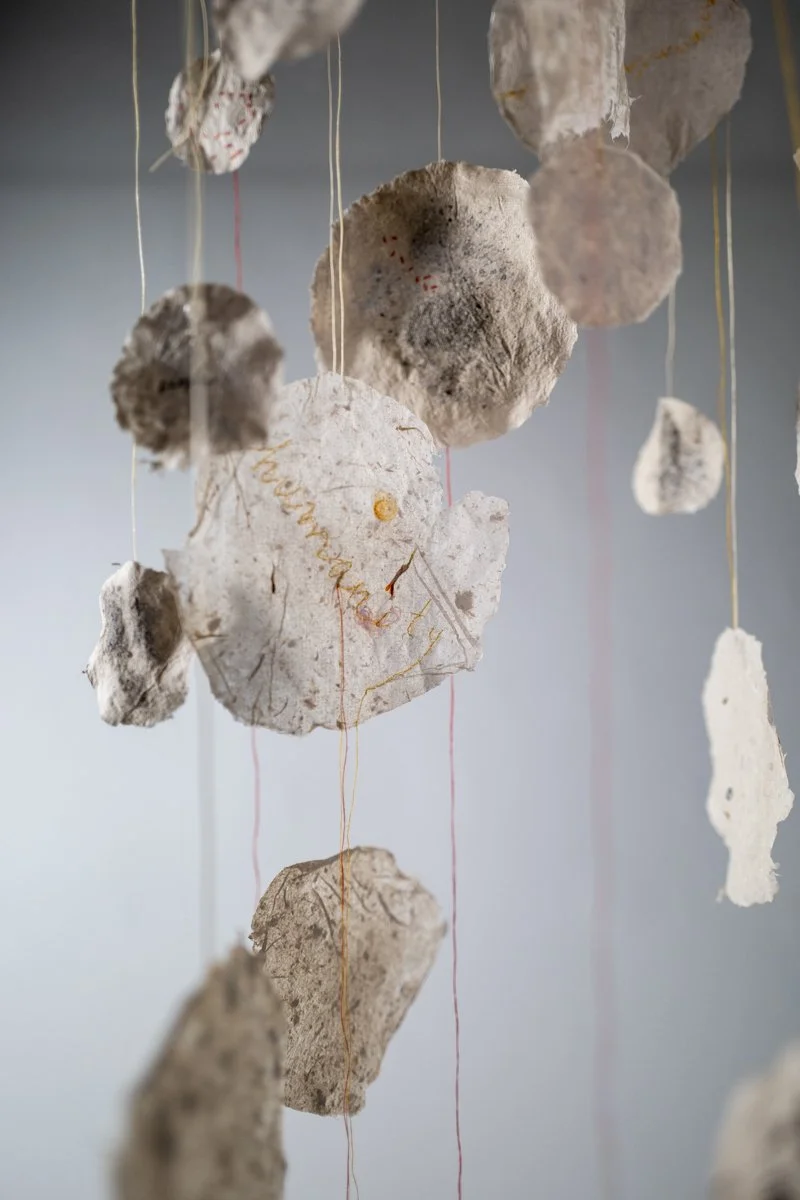
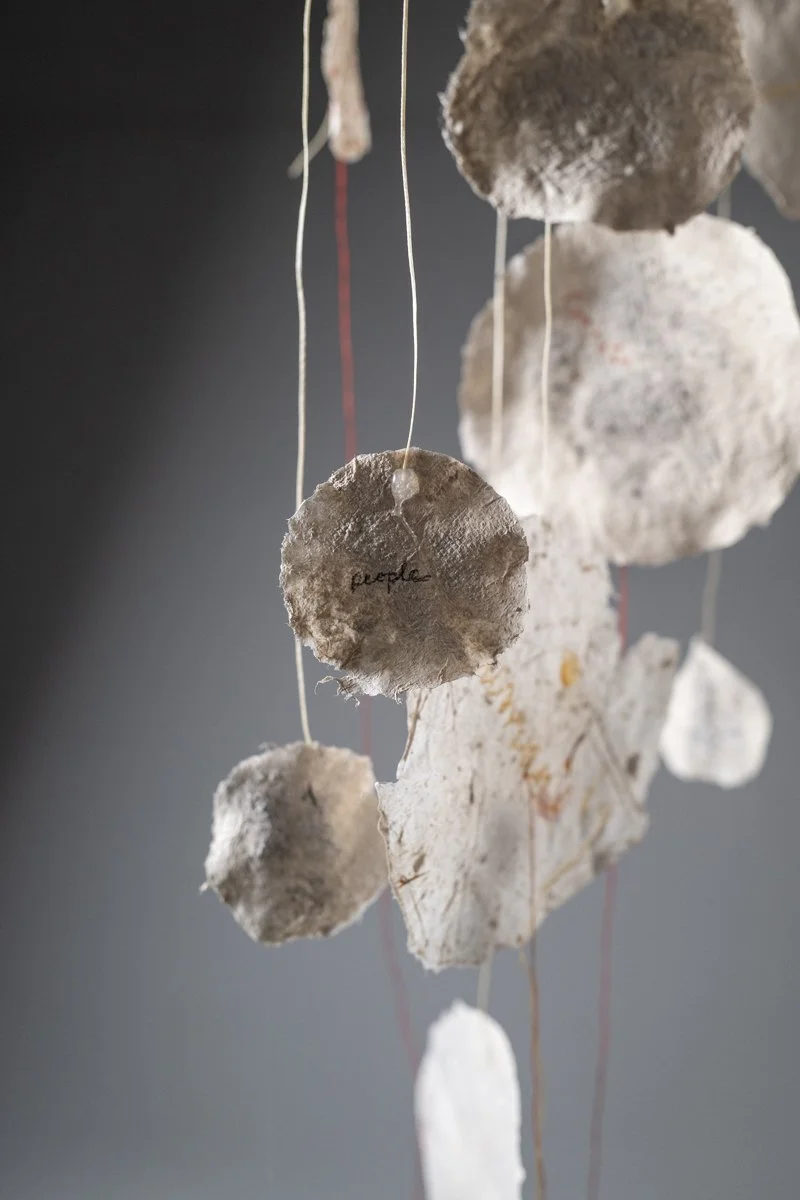
Individual circles 3” to 6”
gold and red linen and silk threads
graphite
Suspended Field (Study)
Work in progress, 2026
Handmade paper (Gampi), suspension thread
4’ x 5’8”
This piece is a study toward a much larger suspended field. This single sheet of handmade paper approaches the scale of a human body, hung so that it moves with the room rather than performing motion for a viewer. It is one of a series of tests leading toward an architectural realization of this work.
The sheet is suspended from multiple points rather than one. Hanging from two or three points lets it sway, almost imperceptibly, the way a breath moves in and out of the body. The paper barely moves. It breathes.
Scale here is not decorative. A sheet built to roughly the proportions of a body changes what a viewer's own body registers standing in front of it, an encounter closer to facing another presence rather than looking at an object. Backlit, the sheet reveals its own construction: individual fibers, clustered pulp, the places where the material is dense enough to hold shadow and thin enough to pass light through. What looks, from a distance, like a single continuous surface is, up close, thousands of individual strands that only became one form by being pressed and dried together.
This work draws on years of research into the idea of a unified field, in physics and in contemplative traditions alike: discrete, fragile units becoming a coherent whole only once they are joined. Kimsooja's use of stillness, duration, and embodied witnessing, particularly in her Needle Woman works, continues to shape how I think about presence that neither performs nor resolves itself for a viewer. Cornelia Parker's suspended forms, held in space by nearly invisible wire so that shadow becomes as much the work as the object itself, are a point of reference for what suspension can do formally: turn absence and structure into visible material. Yoko Ono's instruction-based works, completed only when a viewer offers them their own body and time, shape how I think about participation, not as an add-on to an installation but as the moment a piece actually becomes whole.
This study is a step toward a much larger installation, opening at the University of Notre Dame in January 2027, where the work will be realized at full architectural scale: a single suspended sheet close to twenty feet tall, moving with the room's own air and temperature. Around that large suspended field, I am developing a way of inviting a visitor to stand before the piece for a set duration while it is filmed in wide shot, then giving that footage back to them as their own, with the separate choice, never the requirement, of letting it also join a public loop elsewhere in the installation. What a viewer gives the work, and what they keep for themselves, stays theirs to decide.
Beyond that installation, I am working toward a civic-scale iteration of this research: a public-facing space built in collaboration with people working in fabrication, conservation science, and architecture, open to scientists, philosophers, and the general public as distinct but overlapping audiences. I am not interested in scale as monument or permanence. I want this work to take up space the way breath does, filling a room without asserting itself over it, present enough to be felt by every body that enters and gone the moment attention moves elsewhere. That future space will hold questions of ecological survival and material memory rather than illustrate them, and will invite a viewer's whole body into fragility rather than let them simply observe it.
Breathing on This Land for Another Day
Work in progress, 2026
Handmade paper, ash, thread, graphite and sound
Dimensions variable.
This study is approximately 4’x1.5’. The fully realized version will be a bit larger than 1:1 human scale, approx. 6’x6’ and comprised of a thousand circles of handmade paper.
Breathing on This Land for Another Day begins with the ash of immigration documents. After receiving a visa that allowed him to remain in the United States, a friend ritually burned the extensive paperwork that had been required to secure it. He entrusted the resulting ash to me, along with permission to work with language drawn directly from his writing about the experience.
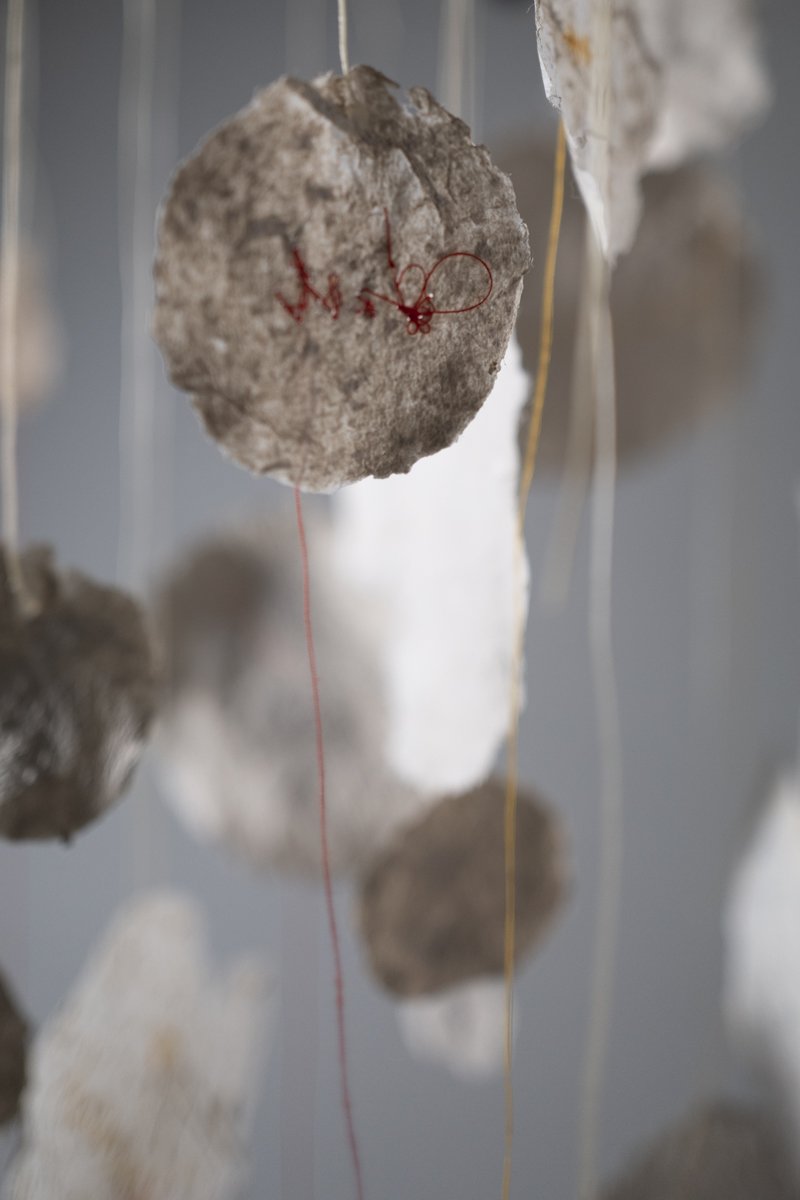
I am incorporating the ash into small, circular sheets of handmade paper. Some hold words written in graphite or embroidered in thread: broken paths, directional marks, interrupted circles. In others, language is pressed so faintly into the paper that it cannot be read. In a few, words are carried within the pulp itself, present in the material but never available to the eye. Red and gold threads move across the pale surfaces and then continue beyond them, hanging loose like unfinished routes. The individual fragments are suspended from pale linen threads, allowing them to rotate, overlap and respond to subtle currents of air.
Suspension operates here as both a physical structure and a political condition. It evokes the extended uncertainty of waiting within immigration systems, when the right to remain, move, work and imagine a future is held within an administrative process. At the same time, the installation considers the ways governments, archives and museums name, classify and fix people and objects within systems of knowledge. These fragments remain tethered, but they are not pinned. Their continual movement resists the stable view of the specimen. No single position offers complete access.
The work's approach to language is informed by Trinh T. Minh-ha's concept of "speaking nearby," rather than speaking about or on behalf of another person. Édouard Glissant's articulation of a "right to opacity" also shapes the work's ethics. Opacity is not treated as absence or refusal, but as the possibility of relation without complete disclosure. One fragment carries his words stitched so they are not legible as letters, present in the work and withheld from it at once. The viewer is offered traces of an experience without being granted possession of it. The words remain my friend's. The work holds them while preserving his agency and privacy.
Kimsooja's performances and video works, particularly A Needle Woman and A Laundry Woman – Yamuna River, India, provide another important point of connection. Her use of stillness, duration and embodied witnessing helps me think about how an artwork can remain present before a complex human reality without attempting to master or resolve it.
The current installation is a small study for a much larger suspended field. I envision the next iteration containing as many as one thousand individually formed paper elements and occupying an architectural volume substantially larger than the human body. Rather than being observed as a discrete object, the installation will take up space insistently. Viewers will encounter it as an atmosphere and a shifting collective body, moving around and beneath a field that alternately obscures and reveals itself.
As the papers turn and touch, they produce a quiet rustling. This sound will become an integral part of the expanded installation. It is created not by any single element, but through proximity, movement and contact. Fragile individually, the fragments together form a body capable of altering the space around it.
The work asks what it means to breathe on this land for another day, and what forms of permission, endurance and transformation make that breath possible.
Suspended Field (Study for larger work ~ 20’ x12’)
Work in progress, 2026
Handmade paper (Gampi), suspension thread
4’ x 5’8”